Recent Posts

Wednesday, May 16, 2012

Inclusion in Prime Time


It’s nice to see inclusion get some exposure on national TV! This Sunday night inclusion champion and recording artist Clay Aiken will compete in the finals of Celebrity Apprentice, playing for his charity the National Inclusion Project. While I don’t watch much TV and haven’t seen the Celebrity Apprentice, I will be tuning in to see the important cause of inclusion in the national spotlight!

I started my career at KIT right as the Bubel/Aiken Foundation (it's original name) was getting off the ground in 2003. In fact, they provided generous funding for our first national conference that same year. Since then we have collaborated on many projects, like the youth-driven I Am Norm campaign. While we go about our work a little differently, both of our organizations are committed to ensuring that all children, regardless of ability, have access to the typical activities of childhood. Congrats to Clay and the National Inclusion Project! We are very excited for you and grateful for the exposure that our cause will get thanks to you! As both of our organizations know, when kids are included together everyone benefits. 

Wednesday, April 25, 2012

A Science Museum Turns the Lens of Inquiry on Itself


How cool is my job? 

In late January I spent a delightful afternoon at San Francisco’s famous Exploratorium as part of the Mott National Conference of Statewide Afterschool Networks. I had been to the Exploratorium as a tourist in the past and always enjoyed it immensely. However, this time was different. I suddenly saw The Exploratorium as a perfect place for natural and authentic inclusion. I looked at The Tinkering Studio and imagined children with a variety of abilities in the space, and that children who may be labeled as having a disability would have a lot of abilities to share and show as they created art and science using the hands on materials. In my mind’s eye I saw children considered “typical” gaining a greater level of understanding and appreciation for their peers with autism. And I saw all kinds of children exploring future interests and possibly even career paths while enjoying the incredible exhibits at the museum. I was inspired! After the tour the staff gathered the participants in the McBean Theater for a talk-back session. I posed the question, “How do you support children with disabilities in museum activities?” I will never forget how the staff looked at me with their eyes large and their hearts open. “We aren’t sure, but we know that children with disabilities come to the museum, and their parents tell us they like it, but we want to know why it works, why it doesn’t work and what we could be doing.” Music to my ears!

This past Friday and Saturday I went back up to the museum to begin helping them get the answers to their questions. I experienced the same openness that I sensed back in January. I gave a “brown bag” talk on Friday and we discussed how the activities of the museum may support the needs of children with a variety of disabilities, and also how their unique sensory environment is challenging to children with certain types of disabilities. I gave them the basic tenets of inclusive practice, and we spent some time on how to make accommodations that would support children and adults with disabilities.

Following the brown bag session, we held a series of 30-minute sessions with staff from different departments. Representatives from volunteer management, field trips, visitor research & evaluation and exhibits came to ask questions and think through how they might make shifts in how they do their work to make it even more accessible to people of all abilities. I was incredibly impressed with the passion that was apparent in each of them. I heard about their previous efforts, like an autism family night that was a collaborative effort with another local agency, and also a lot about their upcoming move to the Piers in early 2013.
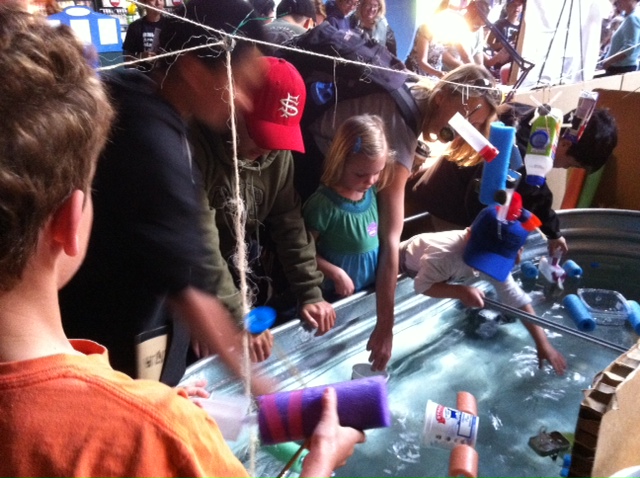
Kids and families enjoying an activity at the Open MAKE

Saturday I was back at the museum to witness their Open MAKE event that involved 90 different “makers” hosting open activities for children and families. A feature of this event was Caine’s Arcade, and there was a line into this 9 year-old's exhibit all day long.
The theme was "trash" and this seal was made all from materials washed up on the Oregon seashore. 

We always remind organizations that inclusion is a journey, not a destination. It doesn’t have a finish line that you cross. The staff at The Exploratorium seems to understand that inherently. They are using their highly-developed inquiry skills to question, “How could we be more accessible?” “What’s working here for children with autism and other disabilities, and how could we incorporate that throughout the museum?” “What challenges do people face in accessing our museum, and how could we help alleviate those challenges?”  KIT is committed to helping them explore these questions, and I am excited to see how they grow as they move to their new, larger space next year. 

Monday, April 2, 2012

On the Road with KIT

Writing to you from Edinburgh, Scotland where I have had a weekend of R&R in between on site visits and trainings. This has been an eventful trip! In the best possible way, of course. After a couple of days in NYC where I had meetings with some brilliant researchers, we (my husband and I) flew to London's Heathrow airport. We arrived at 9:30pm after a delay out of NYC, but were still hoping to be at our hotel and asleep by 11pm to get a jump start on adjusting to the time change. Unfortunately, the customs line at Heathrow took two and a half hours! It was midnight before we were through it and able to leave the airport. We walked outside to the taxi stand and found 50 or so people waiting in line for....no cabs!! One cab came every fifteen minutes, and since it was after midnight there were no other transportation options for getting to our hotel. We finally got there about 2:30am. A rough start!

The next day we had lunch with Stephen Frost, Head of Diversity & Inclusion for the 2012 London Olympics and Paralympics. He shared a lot of interesting information about preparing for the event. They have 2,000 volunteers with disabilities lined up.

By that afternoon we were at the first of three Air Force bases we will visit, RAF Alconbury. The staff there was incredibly welcoming and hospitable. In addition to the trainings and classroom consultations I conducted I had the absolute honor to be the keynote speaker for their Women's History Month event, attended by the leadership of the base and adjoining bases. I was so moved when in the invocation the chaplain asked God to "watch over Torrie as she goes out and does her positive work in the world." I almost lost it at that point!

Tomorrow we are headed to RAF Lakenheath and looking forward to conducting a training on positive behavior for parents! And I hear that some of our friends from Alconbury have organized a carpool to attend the training.

Hopefully I will be able to check in one more time with an update before taking the 11+ hour flight back to San Diego.

Wednesday, March 21, 2012

A Grand Inclusion Adventure!

My bag is packed, my trainings are prepped, my office is clean and I am just about ready for my early morning flight. I will be spending the next few weeks spreading the message of inclusion throughout England! I will start in NYC where I will work with our incredible Research & Evaluation Specialist, meet with our colleague Micaela at Unified Theater and discuss future projects with others in the field.

After 48 hours in NYC I will fly to England to deliver training and support to staff at three Air Force bases. I will be giving a keynote address for a Women's History Month event and (very excited about this) meeting with the Head of Diversity and Inclusion for the London 2012 Olympics and Paralympics.

Check back in- I hope to be able to post some updates on the trip on this blog.

Inclusion is...sometimes a whirlwind!

Sunday, February 26, 2012

Can I Play Too?


If you follow my blog then you already know that I am head-over-heels, crazy in love with the work that I am lucky enough to get to do. Promoting, advocating and teaching inclusion to others is my passion, my purpose and an incredible reason to get out of bed every morning and put on grown-up clothes. Just when I think I have reached the depth of my love for it, something happens that pushes the intensity of my passion even further. This time, that thing was Alex.

                                  Alex is (in the middle in the yellow blouse) in a production of Bye, Bye, Birdie. 

Alex was one of my brilliant dance students when I worked as the education director at a youth theatre organization. I first met Alex when she was 8 or 9 years old when she and her older sister were very involved in everything the theatre had to offer. While her sister loved acting and singing, Alex loved to dance. She was bright, expressive, funny and talkative. I can still hear her laugh in my head. She was also a beautiful dancer, even at 9 years old. Alex was all fluidity with gorgeous long limbs and wonderful feet (I know that sounds weird to non-dancers, but feet are very important to a dancer). Once she graduated from high school I rarely saw her, but got occasional updates from her family until that thing called Facebook happened and we reconnected in real time.

This past week Alex sat in my office and we talked about inclusion. Alex is now the 27-year old mother of a beautiful three-year old girl, Izzy, who was diagnosed with autism last year. As Alex shared her story with me, I was blown away by the woman she has become. All the beauty and grace Alex showed as a young dancer, she is now showing as a mother. She told me about how she approached her pediatrician and asked for some additional testing. “Something wasn’t right. I knew it wasn’t,” she told me. “She wasn’t talking at two years old and when she had tantrums they were very, very intense.” The pediatrician told her “parents don’t usually want to have their kids tested.” Once Alex had a diagnosis she began to educate herself. “I found a lot on the internet,” she shared. As a working, single mom, she doesn’t have a lot of time for activities like support groups, but she has created a foundation of agencies, programs and people that have nurtured her family this past year. Izzy attends an inclusive preschool with her cousin who is seven-months younger, and she receives services through the Regional Center. Alex is adamant that people see Izzy for her strengths, and she talks animatedly about how good Izzy is at using technology, her love for art and the progress she is making at learning new skills. “She is already stringing together 5 and 6 word sentences.” It’s important to Alex that people take the time to get to know Izzy, and that once they do they understand that all it takes is a little adjustment and a little patience, and she’ll be able to do anything any other three-year old does.

This is where the road can be rough for a parent of a child with a disability. After telling me that Izzy loves to kick a soccer ball around she told me “So I called a bunch of soccer clubs that offer programs for three-year olds and none of them would take her, because she can’t follow the drills through the cones.” What? Seriously, how many three-years old are interested in or able to do that? It is hearing this kind of story that really gets my hackles up. But, this isn’t why Alex came to see me.


Alex and Izzy will be moving to Mexico this spring. They will be in one of the smaller towns in southern Baja, where Izzy was born, in order to be closer to her father. Alex wants to ensure that Izzy will be included, in pre-school and then elementary school, and in all aspects of community life. She wants KIT’s help and she sees a vision for educating people about disability and inclusion in Mexico. Alex is willing to do whatever it takes, but she can’t do it alone. Together, with Alex, we will spread the message of inclusion so that children like Izzy can truly know belonging, and so that everyone benefits from being a part of a community that reflects human diversity. KIT exists because of children, like Izzy, who want to play soccer but are told they cannot play. It is incredibly important to me that no child ever has to ask, “Can I Play Too? If this is important to you too, please join me in supporting KIT so that Izzy can say, “I can play too!” 

Tuesday, January 24, 2012

Selecting an Inclusive Program- Tips for Parents


If you are a follower of the work of Kids Included Together (KIT), then you know that we exist to support child development, recreation and youth enrichment programs in including children with and without disabilities. All of our focus goes toward training people who work in these kinds of programs on how to make accommodations so that a child can be successful in the YMCA, Boys & Girls Club or any other out-of-school time program. It’s not about changing the child; it’s about increasing the ability of the adult who is providing the service. Most often the work begins with facilitating an attitude shift. I often say that what we do is help flip that little switch in someone’s brain that tells them that of course they can support a child with cerebral palsy in their after school program. Once the right attitude is there, the barriers fall away and the person becomes focused on creating an inclusive environment. It’s invigorating work. I could go on and on for days about it (just ask my husband!). But you don’t have that kind of time, and today I’d like to look at the other side of the inclusion equation. Families. While we focus on helping child and youth development programs become more inclusive, it does not happen without families. It is a parent who finds the program, makes the inquiry and ultimately decides whether or not to enroll. At KIT it is our fervent desire that more and more parents of children with disabilities will seek to enroll in inclusive programs, and that hopefully knowing organizations like KIT exist will increase their confidence in doing so. To that end, I’d like to offer this post up to parents. If you are beginning to look for a program, whether it’s pre-school, after school, day camp or dance class, here is a list of things to look for and questions you can ask before enrolling in a program:

What to Look for in a Program

1.     Quality first! Programs that are of high quality are programs that can serve children with and without disabilities. Different programs use different quality rating scales, but when you visit you should see evidence of quality (environments, ratios, staff, daily routine, etc). If you are unfamiliar with the aspects of a quality child or youth program, you can ask what accreditation or rating scale the program utilizes. Most are available online.
2.     Is there evidence of a commitment to inclusion? This could be the atmosphere/feeling you get when you visit or call, website and print materials that convey an inclusive mission statement or photos representing diversity. When you speak with administrators or staff members at the program do they use person-first language?
3.    Do you get a sense of an inclusive attitude among the staff you meet? When you are inquiring or enrolling does the staff ask you about your child’s interests, strengths and gifts? Do they ask about your goals for your child in the program? If you are there with your child do they address questions to just you, or do they also speak directly to your child?


5 Questions to Ask

1.    Can I come visit the program when it is in session? It’s important for you to see the program setting when there are children there. A Boys & Girls Club is a whole different place at 10am than it is at 4:00pm. If you are going to be able to tell the staff where your child might need accommodations or extra support, you’ll need to see the program in action and understand the activities, routine and schedule. You also want to see if children are included together in natural environments. Do you see evidence of inclusion?
2.    What systems do you use to communicate with the parents? It can be challenging for program staff to share difficult information with parents. Having a regular method of communication (using a daily journal, email or end-of-day chat, for instance) can help. Be sure you let the program know how you would like to be communicated with, how often and when it is OK to get a call when the child is in the program (Emergencies only? Or is it OK for your child to call you when she needs soothing?). Planning for the communication method on the front-end can save a lot of pain and misunderstanding later on.
3.    Do you have a network of community collaborators? What are the organization’s key partnerships? Have they reached out to local disability organizations? Are they dialed into local social service agencies or resources available from county government?
4.    Does your staff receive training on inclusion, diversity and disability? KIT’s research has shown that people who receive training on inclusion are much more likely to make accommodations for children with disabilities and are also much more likely to see inclusion as their professional responsibility. On-going access to training and information on inclusion for staff is a key indicator of a commitment to inclusion. If you encounter a program that does not offer their staff training on inclusion, you can always direct them to us at KIT.
5.    How do you measure a child’s success in the program? It’s important to know what the program sees as success. If the program is one that aspires to build skills (basketball camp, drama class, swimming lessons) do you get a sense that they will view success in the same way you do? Can they adapt their measure of success to your goals? For instance, some children will never swim in a pool without using floaties. Is the program able to measure successful participation in ways other than independent swimming?

Of course, each individual family will have specific needs and wants in selecting a program. The sensory environment may be of particular interest, or you may prioritize a stable workforce that has been in place a long time, depending on the specific needs of your child. It’s also important to select an activity that your child will enjoy doing and build on their strengths and interests. You are the expert on your child, and the people who will care for your child in the program need the information you have to offer. They may not know exactly how to ask for it, and they may appear hesitant at first. This doesn’t necessarily mean they aren’t equipped to care for your child. Developing a strong partnership between a parent and a program provider is important to creating a successful experience for a child. You are half of this important equation, and together you and the people you choose to teach and care for your child are responsible for creating memories that will last your child’s lifetime.

Inclusion is….a partnership between family and community. 

Tuesday, January 3, 2012

Happy New Year from KIT!


Happy New Year! I love a bright, shiny, clean and fresh new year. It feels good to come back after the respite of the holidays and look at the world with new eyes.  Here at KIT we have a tradition of giving our staff a break the week between Christmas and New Year’s. It’s a time to rest, reflect and come back in January ready to rock. I always love the energy of January, when everyone is refreshed and excited about what the new year holds. We have lots of big plans at KIT, and an awful lot of work that needs to get done this year. We have a smart and creative new marketing director and another super talented digital content producer devoted to turning our curriculum into useful online tools. Our exciting annual fundraiser, Over the Edge for KIT, will come up fast in August and teams are already out there raising money. Perhaps you would like to join us?

All this is really just to say that the KIT team is ready to take on 2012 and spend another year promoting and teaching inclusion, making the world a better place for kids and families and supporting the incredible people who work with children in recreation and child care. If you would like to get involved in this important work, or if you have some ideas about how to make the world more inclusive please be in touch.

Many happy returns for your best year yet!